That camcorder was the size of a horse.
For twenty-eight years I fought the gap between what I could imagine and what the machine would allow. Last week it wasn't there.
Andy
6/3/2026
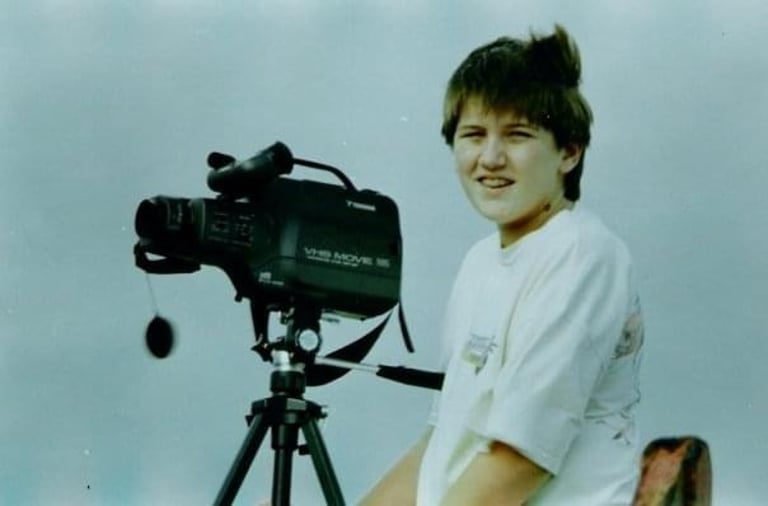
The camcorder was the size of a horse.
I was fourteen. I wanted to make the films I loved — the ones I'd watch and then watch again, trying to work out how they did it. But there was a gap. An enormous gap. Between the thing in my head and the thing that horse-sized camcorder could actually put on tape.
That gap turned out to be my whole career.
VHS. Then DV. Then HD, then 4K. Every format closed the distance a little. Twenty-eight years spent narrowing the space between what I could imagine and what the machine would allow. You get good at fighting the gap. You get clever. Limitation makes you clever — that's a thing nobody tells the kid.
And then, recently, I sat down with these new tools. And for the first time in my life, the gap just... wasn't there.
The thing in my head. It just appeared.
I keep trying to describe the feeling and the only honest version is: I'm fourteen again. It's not excitement about a tool. It's the older, dumber, better feeling underneath that — the disbelief that this is even possible. Wonder, not ambition. The exact thing I felt the first time I understood that people make the things I loved.
Here's what I can't stop thinking about. There's a kid out there right now whose first camcorder can render anything. Cinematic vision, no gap, no horse to carry. What does that kid become? What do they make that I can't even picture?
The tool was never the point. The wonder was. And the wonder just got handed to everyone at once.
The gap closed on the machine. It never closes on the story. That part's still all of ours to figure out.
The difference between AI slop and AI that genuinely serves a story isn't the technology. It's the same difference it's always been — vision. The eye. The twenty-five years of knowing which frame matters, which cut lands, which image earns its place and which one is just filling space. AI in the wrong hands is noise. AI in the right hands is permission — permission to build worlds that budgets couldn't reach, to create shots that simply didn't exist, to bring ideas to life at a scale previously reserved for the very top of the industry.
Worlds that would require three location scouts, two flights, a permit nightmare, a weather window, and a carbon footprint you'd rather not calculate. Made. Without a single flight.
Here is what I'm offering. Not AI content. Not generated assets. Not the machine running loose. I'm offering what I've always offered — a storyteller, with a tool, pointed at your idea, asking: what do you want the person on the other end to feel?
Whether it's footage in your final cut. Environments for your pre-vis. Shots for your development deck. Campaign imagery for your pitch. The question is always the same as it was in that garden in the 1990s. The tool is new. The craft isn't. Nothing's wasted — it was all training ground for exactly this.
Here is what I know. The tool is never the point. It never was. The camcorder wasn't the point. The edit suite wasn't the point.
The story is the point — it always has been, it always will be.
Every new tool that arrives gets picked up by two kinds of people. The ones who use it to make noise. And the ones who use it to say something.
I've spent twenty-five years learning the difference.
That kid in the garden already knew which one he wanted to be.