I was ten years old. And I already knew.
A VHS camcorder. Twenty-five years. An Emmy and a BAFTA. And now a new tool that feels exactly like the first one did — and why that matters for your next project.
FEATURED
Andy
6/3/2026
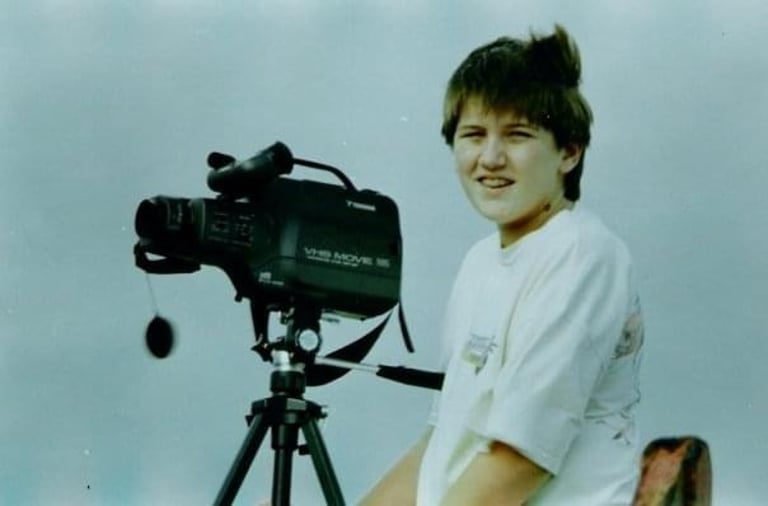
I was 14 years old. And I already knew.
If I could point this thing at the world — I could make people feel something. That was the thought. I didn't have the language for it at ten years old, standing in the garden with a VHS camcorder the size of a small dog. But the feeling was completely clear. This machine, in my hands, pointed at something real — could move a person who wasn't there.
That feeling never left. It just found better tools.
DV tape arrived and suddenly I could capture images that looked genuinely broadcast quality. Then HD. Then 4K. Each time, a new tool landed and the same instinct fired — not excitement about the technology, but excitement about what the technology unlocked. What story could I tell now that I couldn't tell before? What feeling could I create that was previously out of reach?
Twenty-five years of that question. BBC. Netflix. Disney+. An Emmy. A BAFTA. Thousands of hours of other people's stories, cut and shaped and sent out into the world to make someone on a sofa somewhere feel something they didn't expect to feel. That's the job. That has always been the job.
Then the world changed again.
You've seen the AI content. The slop. The images that feel generated, the videos that feel assembled, the endless output that has no soul behind it and no eye in front of it. The content that was made because it could be, not because it should be. I understand the scepticism. I felt it too. Until I recognised a feeling I'd had before — standing in a garden with a VHS camcorder.
That camera didn't just smell incredible — though it did, and if you know, you know — it gave me something I hadn't had before. A way in. I was never going to be the kid who could draw. Couldn't paint. Couldn't pick up a pencil and make something appear on a page that looked like the thing I saw in my head. But a camera? A camera I could point at the world and capture something real. Shape it. Show it to someone. And watch them feel it.
That was the door opening.
Every creative person has a moment where they discover their method — the thing that bridges what's inside their head and what other people can actually experience. The camcorder was mine. Not because I was the best person holding one. But because holding one meant I could make something. Something people would watch. Something they'd enjoy. Something that might — if I got it right — make them feel something they didn't expect to feel.
And now I'm standing in that doorway again.
The difference between AI slop and AI that genuinely serves a story isn't the technology. It's the same difference it's always been — vision. The eye. The twenty-five years of knowing which frame matters, which cut lands, which image earns its place and which one is just filling space. AI in the wrong hands is noise. AI in the right hands is permission — permission to build worlds that budgets couldn't reach, to create shots that simply didn't exist, to bring ideas to life at a scale previously reserved for the very top of the industry.
Worlds that would require three location scouts, two flights, a permit nightmare, a weather window, and a carbon footprint you'd rather not calculate. Made. Without a single flight.
Here is what I'm offering. Not AI content. Not generated assets. Not the machine running loose. I'm offering what I've always offered — a storyteller, with a tool, pointed at your idea, asking: what do you want the person on the other end to feel?
Whether it's footage in your final cut. Environments for your pre-vis. Shots for your development deck. Campaign imagery for your pitch. The question is always the same as it was in that garden in the 1990s. The tool is new. The craft isn't. Nothing's wasted — it was all training ground for exactly this.
Here is what I know. The tool is never the point. It never was. The camcorder wasn't the point. The edit suite wasn't the point.
The story is the point — it always has been, it always will be.
Every new tool that arrives gets picked up by two kinds of people. The ones who use it to make noise. And the ones who use it to say something.
I've spent twenty-five years learning the difference.
That kid in the garden already knew which one he wanted to be.